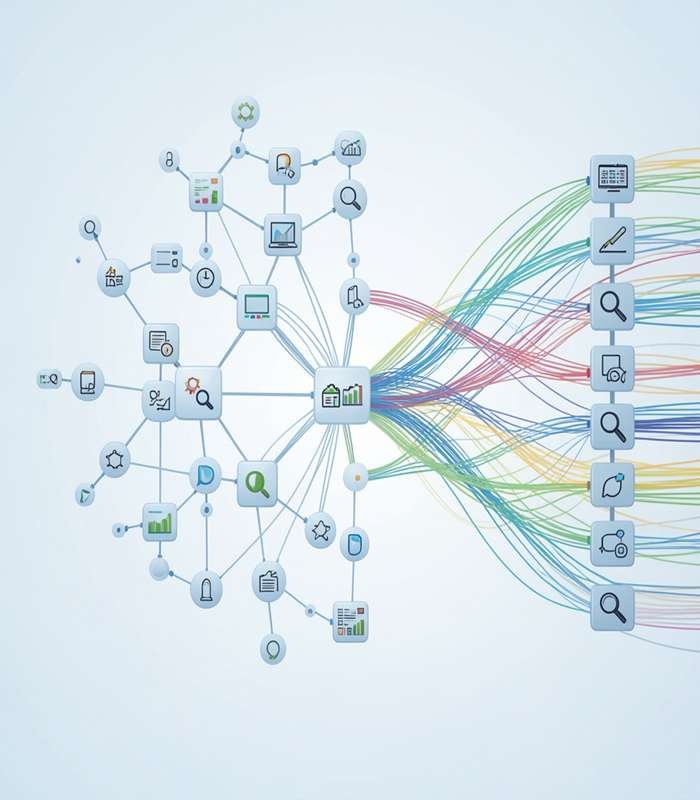
Internal links are one of the most powerful and underused tools in SEO. They help search engines discover pages, understand relationships between topics, and see which pages matter most. In AI search, where systems evaluate topical depth and retrieve passages from across your site, a thoughtful internal linking structure becomes even more important.
This guide introduces a simple model, linking up, sideways, and down, and shows how to use it to strengthen your visibility in both traditional and AI search.
Why Internal Links Matter for AI Search
Discovery
Crawlers follow links to find pages. Pages with few or no internal links, often called orphan pages, may be crawled less often or missed entirely, including by AI crawlers.
Context and Relationships
Links and their anchor text help machines understand how pages relate. A link from “AI SEO strategy” to “AI crawler list” with descriptive anchor text signals a meaningful connection.
Topical Authority
A well-linked cluster of pages on a subject shows depth and organisation, supporting the perception of expertise. See our guide to AI SEO ranking factors.
Importance Signals
Pages that receive more internal links from relevant pages are generally treated as more important within your site.
User Journeys
Links guide readers to the next logical step, from learning to comparing to acting, which improves engagement and conversions.
The Up, Sideways and Down Model
Think of your content as a hierarchy: pillar pages at the top, cluster pages below, and supporting pages beneath those.
Linking Up
Every cluster and supporting page should link up to its parent pillar page. This tells search engines which page is the main resource on the topic and passes relevance upward.
Example: An article on “How to Allow OAI-SearchBot” links up to a pillar page on “AI Search Visibility.”
Linking Down
Pillar pages should link down to cluster pages that cover subtopics in depth. This helps users and crawlers explore details and distributes authority to supporting content.
Example: A pillar page on “AI SEO” links down to guides on AI crawlers, schema markup, and content optimisation.
Linking Sideways
Related pages at the same level should link to each other where relevant. This connects subtopics and helps machines understand the breadth of your coverage.
Example: A guide on “Person Schema” links sideways to “Organization Schema” and “Brand Entity Consistency.”
| Direction | From | To | Purpose |
|---|---|---|---|
| Up | Cluster or supporting page | Pillar page | Reinforce main topic authority |
| Down | Pillar page | Cluster pages | Distribute authority, enable exploration |
| Sideways | Cluster page | Related cluster pages | Show topic breadth and relationships |
Anchor Text Best Practices
- Be descriptive: “our guide to AI search citations” is better than “click here”
- Be natural: anchors should fit the sentence and reflect the linked page’s content
- Vary thoughtfully: use natural variations rather than repeating the exact same phrase everywhere
- Avoid over-optimisation: do not stuff exact-match keywords into every anchor
Where to Place Internal Links
- In the body content: contextual links carry the most meaning
- In introductions: link to foundational concepts early
- In “related guides” sections: list closely related articles
- In navigation and breadcrumbs: reflect site hierarchy
- In FAQs: link to pages that expand on answers
Contextual links within relevant paragraphs are especially valuable because they combine the link with surrounding meaning.
How Many Internal Links?
There is no fixed number. Add links where they genuinely help readers. A long guide may naturally include many; a short article fewer. Avoid linking every other sentence or adding irrelevant links.
Common Internal Linking Mistakes
- Orphan pages with no internal links pointing to them
- Generic anchor text such as “read more” or “here”
- Broken internal links after URL changes
- Linking only through navigation menus without contextual links
- Deep pages buried many clicks from the homepage
- Competing pages targeting the same topic without clear hierarchy
An Internal Linking Workflow
- Map your topic clusters: identify pillars, clusters, and supporting pages
- Audit existing links: use a crawler to find orphan pages and weakly linked content
- Add up links: ensure every cluster page links to its pillar
- Add down links: update pillars to link to all relevant cluster pages
- Add sideways links: connect related subtopics
- Improve anchor text: replace generic anchors with descriptive ones
- Fix broken links and redirects
- Repeat when publishing new content: link new pages into the structure immediately
Internal Linking and AI Citations
When AI systems retrieve content, they may encounter multiple pages from your site. A clear internal structure helps them understand which page is the most comprehensive resource and how related information connects. It also ensures new pages are discovered quickly. For more on how AI systems choose sources, see AI search citations.
Final Thoughts
Internal linking is how you show search engines and AI systems the shape of your expertise. Link up to pillars, down to details, and sideways between related topics, using descriptive anchors that explain each connection. For site-level planning, see our guide on AI SEO strategy for businesses, and use our AI SEO checklist to review your linking regularly.
Frequently Asked Questions
Why do internal links matter for AI search?
Internal links help crawlers discover pages, show relationships between topics, signal important pages, and demonstrate topical depth, all of which help AI systems understand and retrieve your content.
What is the up, sideways and down model?
It is a linking approach where cluster pages link up to pillars, pillars link down to clusters, and related cluster pages link sideways to each other, creating a clear topical structure.
What anchor text should I use for internal links?
Use descriptive, natural anchor text that explains what the linked page covers, such as a guide’s topic, rather than generic phrases like click here or read more.
How many internal links should a page have?
There is no fixed number. Add links wherever they genuinely help readers explore related information. Long guides may include many links, while short articles naturally need fewer.
What is an orphan page?
An orphan page has no internal links pointing to it. Crawlers may miss or rarely revisit such pages, so every important page should be linked from relevant content.
How often should I review internal links?
Review internal links whenever you publish new content and run a full audit quarterly to find orphan pages, broken links, weak anchors, and gaps in your topic cluster structure.